How to Choose the Right Exhaust Fan Motor for Your Needs?
Choosing the right exhaust fan motor can significantly impact indoor air quality and energy efficiency. According to the U.S. Department of Energy, proper ventilation can reduce indoor pollutants by up to 50%. An appropriate exhaust fan motor not only helps in maintaining a comfortable environment but also conserves energy.
When selecting an exhaust fan motor, consider its capacity, efficiency, and type. Motors come in various sizes and power outputs. A motor too powerful can lead to unnecessary energy consumption, while one that is too weak may fail to provide adequate ventilation. Studies reveal that using correctly sized motors can optimize energy use by 30% or more.
Understanding your specific needs is crucial. Different applications require different motors. Industrial settings demand heavy-duty models, while residential spaces benefit from quieter, energy-efficient options. Taking the time to assess your requirements can ensure reliable performance and longevity of your exhaust system. Remember, a choice made without careful consideration can lead to inefficiencies and higher costs in the long run.

Understanding the Fundamentals of Exhaust Fan Motors and Their Types
When selecting an exhaust fan motor, understanding its types is crucial. There are primarily two categories: AC and DC motors. AC motors are widely used for their durability and ability to handle high loads. They are simpler and often more reliable. However, DC motors are becoming popular for their energy efficiency and quieter operation. A recent industry report states that as energy costs rise, many are shifting towards DC motors.
In terms of performance, consider the fan's CFM (Cubic Feet per Minute) rating. This measures airflow and is essential for proper ventilation. A good rule of thumb is to provide at least one CFM per square foot of space. However, larger areas might require more powerful motors. One study indicated that improper motor selection can reduce efficiency by up to 30%. This highlights the need for careful evaluation.
Even with solid data, the choice can be challenging. Many users overlook factors like mounting type and noise levels. Not considering these may lead to dissatisfaction or poor performance. A focus on both technical specifications and practical applications is essential for making an informed decision.
Evaluating the Airflow Requirements: CFM Calculation for Exhaust Fans
Choosing the right exhaust fan motor starts with understanding your airflow needs. CFM, or cubic feet per minute, measures how much air the fan can move. To determine the right CFM, consider the size of the space and the activities taking place. A kitchen, for instance, requires more airflow than a small bathroom.
Measuring room volume is crucial. Calculate the area by multiplying the length, width, and height. Then, to find the minimum CFM, use a simple formula: divide the total volume by the number of air changes per hour recommended for your specific application. Generally, a kitchen might need 15 air changes per hour, while a bathroom might only need 8. This step is often overlooked, leading to either insufficient ventilation or excessive energy costs.
Selecting a motor that meets these CFM requirements is essential but not always straightforward. Some might think that a higher CFM guarantees better performance. However, an overly powerful fan can create noise and lead to higher energy bills. Reflecting on comfort and efficiency is vital when making a choice. An undersized motor won't ventilate effectively, while an oversized one can disrupt airflow patterns. Balancing these factors is key to achieving optimal performance.
Assessing Motor Power Ratings: Choosing Between Watts and Horsepower
When selecting an exhaust fan motor, understanding power ratings is crucial. You often see two main measurements: watts and horsepower. Watts measure electrical consumption, while horsepower focuses on mechanical power output. Choosing the right unit depends on your specific needs.
For small applications, like bathroom vents, low wattage motors often suffice. They consume less energy and cost less to operate. However, larger spaces or industrial setups require higher horsepower. Don’t overlook that sometimes a lower horsepower motor can work efficiently if it operates at optimal speeds.
Assessing motor specifications involves examining airflow and efficiency. An energy-efficient motor can provide the same performance as a larger one but with lower energy consumption. It’s important to compare these ratings critically. Ensure you’re not overpaying for excess power you don’t need. A thorough understanding of these elements can guide you towards a motor that aligns with your operational goals.
Factors Affecting Motor Efficiency and Performance in Ventilation Systems
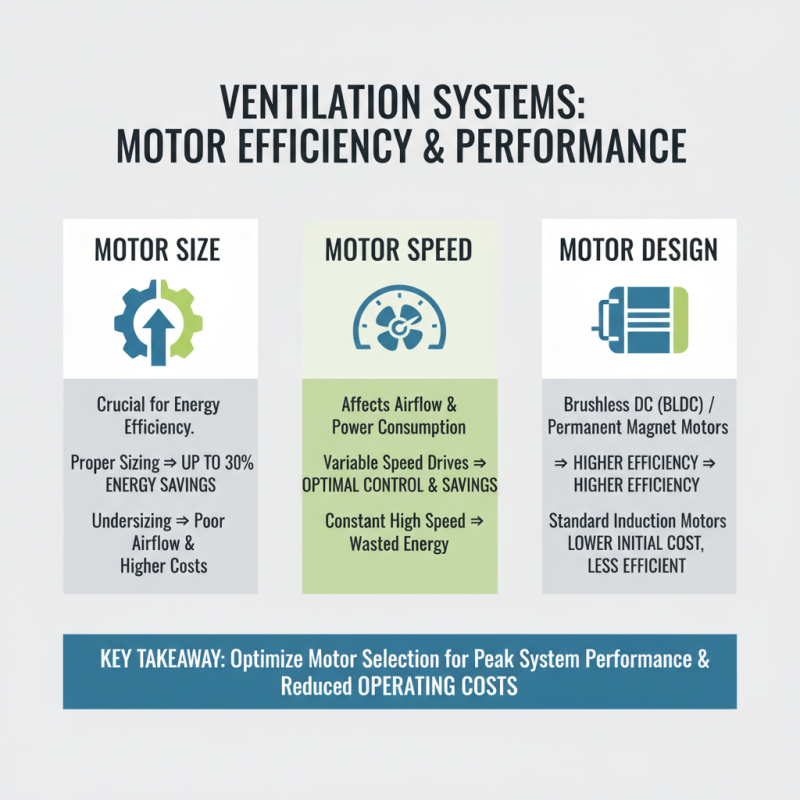
When selecting an exhaust fan motor, efficiency and performance are crucial. Several factors influence these aspects, including motor size, speed, and design. According to industry research, a properly sized motor can improve energy efficiency by up to 30%. Underestimating the needed capacity can lead to decreased air circulation and increased energy costs.
The type of motor also matters. Permanent split capacitor motors, for example, offer higher efficiency than shaded pole motors. Data shows that they can achieve efficiency ratings above 70%. Additionally, the venting method can affect the motor's performance. Duct design clarity has a significant impact on airflow. Poorly designed ducts can reduce airflow by 30%, wasting energy.
Noise levels are another consideration. While some motors operate quietly, others can produce unwelcome sounds. These sounds not only distract but can indicate inefficiencies. Regular maintenance can detect such issues early, ensuring optimal performance. Ultimately, understanding these factors helps in making informed decisions.
Identifying the Suitable Environment: Indoor vs. Outdoor Exhaust Applications
When selecting an exhaust fan motor, understanding your environment is essential. Indoor and outdoor applications present different challenges. Indoor environments often require quieter options. Look for motors designed for noise reduction. Meanwhile, outdoor settings typically handle larger volumes of air. Durability is a key factor here.
**Tip:** Always check the motor's IP rating. It indicates how well it resists dust and moisture. For outdoor use, an IP65 rating is a smart choice. It prevents water and dust from affecting the motor’s performance.
Consider the purpose of your exhaust system. Are you venting kitchens or controlling humidity in basements? Each scenario may demand a unique motor. If you overlook the required power output, inefficiency can occur. Balancing airflow and noise levels may require some reflection on your specific needs.
**Tip:** Regularly maintain your exhaust system. Dust buildup can impair motor function. A clean motor runs better and lasts longer. Periodic checks can prevent unexpected failures.
Exhaust Fan Motor Selection: Indoor vs. Outdoor Environments



 Email
Email Whatsapp
 WeChat